
A note from the founder
11 years ago, I was living in a van — chasing The Masters.
What those years taught me about who actually gets better at golf became the app I wish I'd had. Here's the whole story.

The pursuit was simple and the odds were not: The Masters. I slept in a van, chased the game across every course that would have me, and gave it everything I had. Most people saw a kid throwing his twenties away on a dream. I saw the only thing I wanted.
I'd earned my place on the golf team at San Diego State, alongside players like J.J. Spaun, who would go on to win the 2025 U.S. Open. I'd seen the very top of this game up close. I just hadn't gotten there myself yet, and I was willing to live in a parking lot to find out if I could.

But the van taught me something no lesson ever did. When all you have is time and a golf ball, you start to notice what actually moves the needle, and what doesn't.
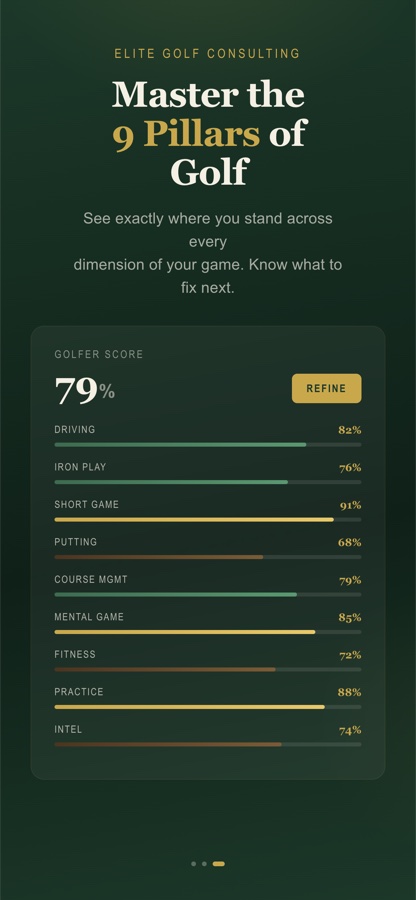
Here's what I learned, and it's the whole reason this app exists: the golfers who improve and the golfers who just play aren't separated by talent. They're separated by what they pay attention to. There are a handful of things (I count nine) that quietly decide every round. Most golfers can't name three of them. So they grind on the wrong stuff for years and wonder why they've plateaued.

By the way: that complimentary assessment you just took? That was the first pillar. You worked it before you even got here. The other eight? Barely anyone can name them. They're waiting inside the app.
The one line I wrote every night
Every single night in that van, I wrote one sentence and forced myself to finish it:
"Today I improved because…"
Some nights the answer was my wedges. Some nights it was my head. It didn't matter what it was. What mattered was that the question made me find the one thing. That sentence is what kept me moving toward Augusta when nothing else did.
And it nearly got me there. I made it to the round of 32 at the U.S. Mid-Amateur: five match-play wins from the title, and the invitation to The Masters that comes with it. Five players. That's all that stood between me and Augusta National.
I didn't get past them. And then I did the hardest thing I've ever done in this game: I put the clubs away. For ten years. I had to build a life that could stand on its own, to get financially stable, to live on my own terms. The dream didn't die out there. It just waited.
Why the sentence changed
Now I'm picking the clubs back up for one more run at The Masters. And this time the line I write is different, because I finally see the flaw in the old one. I wrote it alone. I was tired of carrying all of it by myself: grinding solo, guessing solo, chasing it solo.
Here's what I know now that I didn't then: you can't build any part of your game alone, on the course or off it, and expect to go far. So the sentence isn't "I" anymore.
"Today we improved because…"
That van was a lonely place. Just me, a parking lot, and a golf ball. And it wasn't that I didn't know good players. I did. It's that building your game alone is lonely, and it's nowhere near as fun. On a team, you compete together, you practice together, you work out together. After college, all of that is gone. The circle gets smaller every year, and the game gets tougher, with more pressure riding on every round.
Because here's what San Diego State taught me that the van confirmed: proximity is the fastest teacher in golf. I got good playing next to players who were better than me. Their standards became my standards. And the course gives you more than a lower handicap. Some of the best relationships of your life, for guys and girls alike, start over eighteen holes. It's the last place left where you get four uninterrupted hours with another human being.
I built Elite Golf Consulting to change that. The biggest thing inside this app isn't a stat. It's people. That's the major feature. A community of golfers who are all trying to get better: trading the wins and the setbacks, keeping each other honest, chasing the same thing at the same time, wherever you are, wherever you travel. And when you hit the wall the numbers can't explain, you can take the question straight to elite and pro players, right inside the app. There's someone to talk golf with 24/7. Nobody has to do this from a parking lot alone.
The pillars nobody talks about
Here's what all those years really taught me, from the van to the tournaments to playing alongside guys like J.J. Spaun and Xander Schauffele: there are pillars of this game that quietly decide your scores, and I have never once heard a coach or a YouTube channel talk about them. Not one.
When you get inside the ropes with players at that level, you stop staring at the golf swing and start seeing what actually moves the needle. And it's rarely what you're being sold.
I wish I'd known these things when I first picked up a club.
It would have saved me a decade of grinding on the wrong stuff. And here's the part I love most: this system doesn't just sharpen tour players. It gets high-handicappers better faster than anything I've seen, because for the first time they're finally working on the things that actually matter, on the course and off it.
Which brings me to the secret almost no one will tell you: some of your biggest gains come when you're not grinding at all. So much of this game is won away from the course, and learning to be at peace with the days you don't practice is its own quiet kind of progress.
So I built the thing I wish I'd had
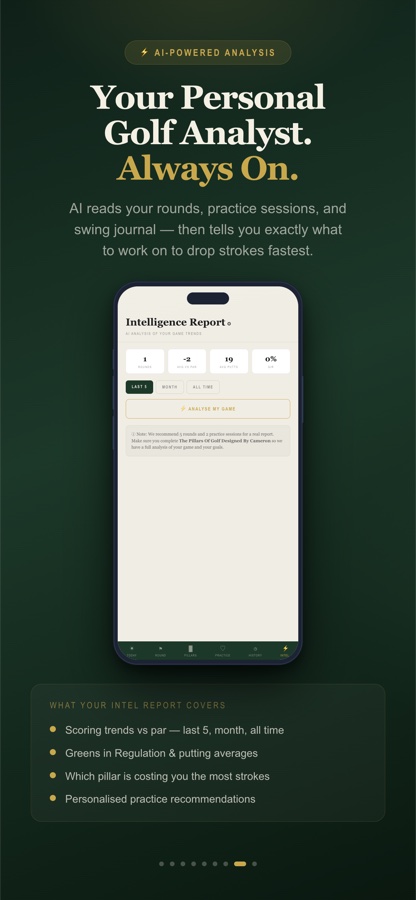
Elite Golf Consulting is that van notebook, rebuilt for your pocket: a performance tracker and a journal in one. It scores your game across all nine pillars and shows you exactly where you're leaking strokes. It tracks the numbers that actually move your handicap (fairways, greens, putts, up-and-downs, your wedge score) and hands you an AI report after every round, like a Tour caddie who read your stats before you got to the car.
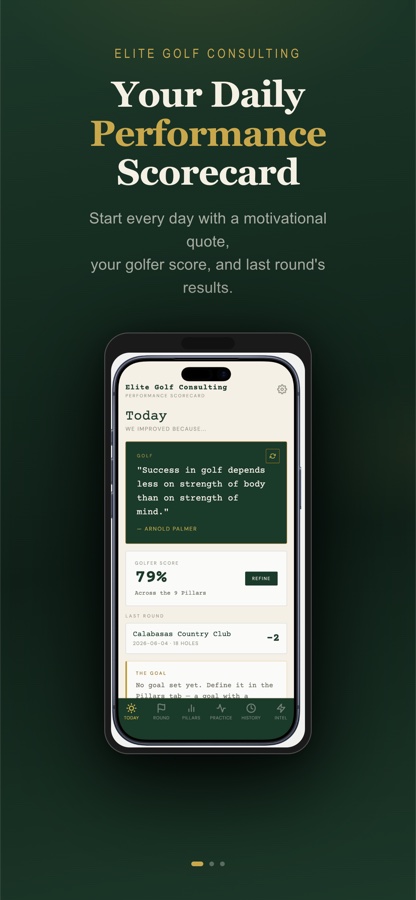
And every day, it asks you the same question I asked myself in that van: what's your line today?
The most important thing isn't a number
Here's what those years really taught me: the stats are cool, but they aren't the point. How you feel standing over the ball — settled or scattered, sure of it or fighting it — is everything. It decides more rounds than any statistic on earth, and it's the one thing almost nobody bothers to track.
So we track that too. Every entry is a line in a history book of your swing: your feels, your thoughts, how the game felt that day. The AI keeps the record you'd never keep yourself: your swing feels, how they've evolved, how you've evolved. And one day you look back and actually see it. Not a perfect swing, but a game that grew, round by honest round.
Everyone else is chasing perfection. We're chasing progress.
Progress you can feel. And finally, progress you can see.
It's free. All of it.
The full membership — the 9 Pillars, Ask-a-Pro, the community — used to run $72 a year. Not anymore. This is the app I wish I had when I was chasing it, so I made it completely free for every golfer who wants to get better.
Download it, log in, and everything unlocks — the system, the pros, and the players walking it with you. Nothing to decide, nothing to cancel. Just get better.
And it isn't just you. Inside the app there's a community finishing the same sentence, chasing the same thing, with 25,000 more of us alongside it. Because results aren't built alone. They're built together, one honest line at a time.
The gap between good and great is measurable.
Start measuring it today.