Get Better
How to Shoot 69: The Blueprint for Breaking 70 for the First Time
If you're a 3 handicap who has been close a dozen times and never once seen a 6 in front of your score, this is for you. The round is simpler than you've been making it.

The 60s are a strange wall. If you're a 3 handicap, you've already shot 71. You've shot 70 and stood on 18 needing a par and made five. You've had the front nine that had it and the back nine that didn't. You own every shot required — that isn't in question anymore, and it hasn't been for a while.
What you don't have yet is a plan for where the three shots come from. So you go out and try to play a good round, which is not a plan, and then you get to 14 at one under and start doing math you've never done before, and the wheels come off in a way that has nothing to do with your golf swing.
Here's the blueprint. It's straightforward, it's boring, and it's completely doable for anyone playing off a 3. On a par 72, 69 is three under. That's four birdies and one bogey. That's the whole round. Let me show you exactly where they live.
Step 1: Play the par 5s at two under
For a low handicap, the par 5s are the easiest holes on the golf course. Not the most exciting — the easiest. You get two full swings before the ball has to go anywhere precise, and on most courses two of the four are reachable in two, or close enough that you're chipping from 30 yards with a wedge in your hand and a good angle.
So set the target before you tee off: two under across the four par 5s. Two birdies, two pars. You don't need all four. You don't need an eagle. You need to take the two that the golf course hands you, and not do anything stupid on the other two.
Notice what that quietly demands: on the par 5s you don't birdie, you make five. Not six. The par 5 bogey — the one where you go for it from 250 out of a flyer lie, short-side yourself in the bunker, and walk off with six — is the single most expensive hole in a round like this, because it's the hole you were supposed to be gaining on.
Two under after four holes' worth of work. Fourteen holes to go, and now you only need one more shot.

Step 2: Play the par 3s at even
Par 3s are the hardest holes in golf relative to par. That's true on the PGA Tour — par 3s are where the best players in the world give shots back, and par 5s are where they take them — and it's true at your club too. One swing, and it has to be the right number, the right shape, and the right miss. There's no recovery hole built in.
So don't try to gain here. Play all four par 3s at even par and you are in tremendous shape. Four pars, nothing given away, on the four hardest holes on the card.
Practically, that means one thing: aim at the middle of the green. Not at the flag tucked behind the front bunker. The par 3 birdie is a bonus, and bonuses are not allowed to cost you a bogey. If you take the middle every time, you'll two-putt three of them and probably run into one 15-footer that goes in anyway.
Still two under. Ten holes left — the ten par 4s — and you need exactly one more shot out of them.
(Check the card before you play. Some par 72s run five par 3s and five par 5s, and a few tilt the other way. The hole count shifts. The blueprint doesn't.)
Step 3: Plan for one bogey — on purpose
This is the part that makes the whole thing work, and it's the part nobody writes down. You are going to make a bogey. Put it in the plan now.
We are not trying to play perfect golf to break 70. That's the misunderstanding that has cost you this round four or five times already. Somewhere around the 11th you make a bogey, and instead of it being a scheduled, budgeted, completely fine event, it becomes evidence that today isn't the day — and the next three holes get played by a guy trying to get a shot back.
Budget it. One bogey on the par 4s. When it comes, you say that's the one, and you walk to the next tee with your plan fully intact. The round is not fragile. It was built with the bogey already in it.
So across ten par 4s you need to be one under: one bogey, two birdies, seven pars. Which brings us to the only two shots in this entire round that require you to actually do something special.
Step 4: Hit one wedge tight — birdie number three
Somewhere in those ten par 4s there's a short one. A hole where you've got a wedge in your hand from 110 and a good lie and no reason on earth not to hit it to eight feet.
That's birdie number three. One wedge shot, hit the way you hit it on the range fifty times a week.
Here's the thing about that shot: it's not a talent problem, it's an attention problem. Most low handicaps hit the wedge with about 60% of the focus they give a 5-iron, because the 5-iron feels hard and the wedge feels automatic. Then they airmail it to 40 feet and shrug. Give that one shot your full number, your full commitment, your full pre-shot routine — and give the ball a chance to end up under the hole where the putt is straight uphill.
Step 5: Make one putt from 20 feet — birdie number four
The last one you don't force. You just have to be there for it when it comes.
Over eighteen holes of decent iron play you're going to have four or five looks from 15 to 25 feet. Statistically you're not making most of them, and that's fine — you need one. One mid-range putt, all day.
And that one putt does something the other three birdies don't. It's the momentum builder. It's the one where the ball disappears and something in your chest goes oh — today's the day, and you walk to the next tee three feet taller. Every player who has broken 70 for the first time can tell you which putt it was.
So give them all a chance. Get the speed right — die it at the hole so a miss leaves you a tap-in instead of a knee-knocker back. Which is really a putting stat conversation, and there's one number that decides it.
The number underneath all of it: 32 putts
Add up the plan and you'll find one stat holding the whole thing together. Get in under 32 putts and you will shoot a number.
Thirty-six putts is two a green. Thirty-two means you converted four greens into one-putts — which is exactly your four birdies, assuming you didn't three-putt anywhere. That's the arithmetic. Under 32 and the score takes care of itself; over 34 and it doesn't matter how well you struck it, the 60s were never available.
Which also tells you where the round actually gets lost: the three-putt. One three-putt eats an entire birdie, and it's almost always a speed problem, not a stroke problem. If you want the drill for it, I wrote it out here — the putting practice that actually ends three-putts.
The one thing that ends the round: the big mistake
Everything above assumes one thing. No lost ball. No out of bounds. No card-wrecker.
Look at the budget: four birdies, one bogey. A lost ball is a two-shot penalty on top of a hole you were already in trouble on — that's a double, minimum, and a double erases two of your four birdies in one swing. The plan has no room for it. Not because you have to be perfect, but because that particular mistake is the only one big enough to matter.
So the tee shots get boring on the two or three holes where trouble is genuinely in play. 3-wood. Hybrid. Whatever your in-play club is. You're not trying to overpower a golf course to shoot 69 — you're trying to keep eighteen holes of ordinary golf uninterrupted. That's the same logic that gets a 95-shooter to 89, just moved up a level: breaking 90 is arithmetic too.
The whole blueprint, on one card
Write this on the back of your scorecard before you tee off:
Two under on the par 5s. Even on the par 3s. One under on the par 4s.
One wedge hit tight. One putt made from mid-range. One bogey, already forgiven. Under 32 putts. No lost balls.
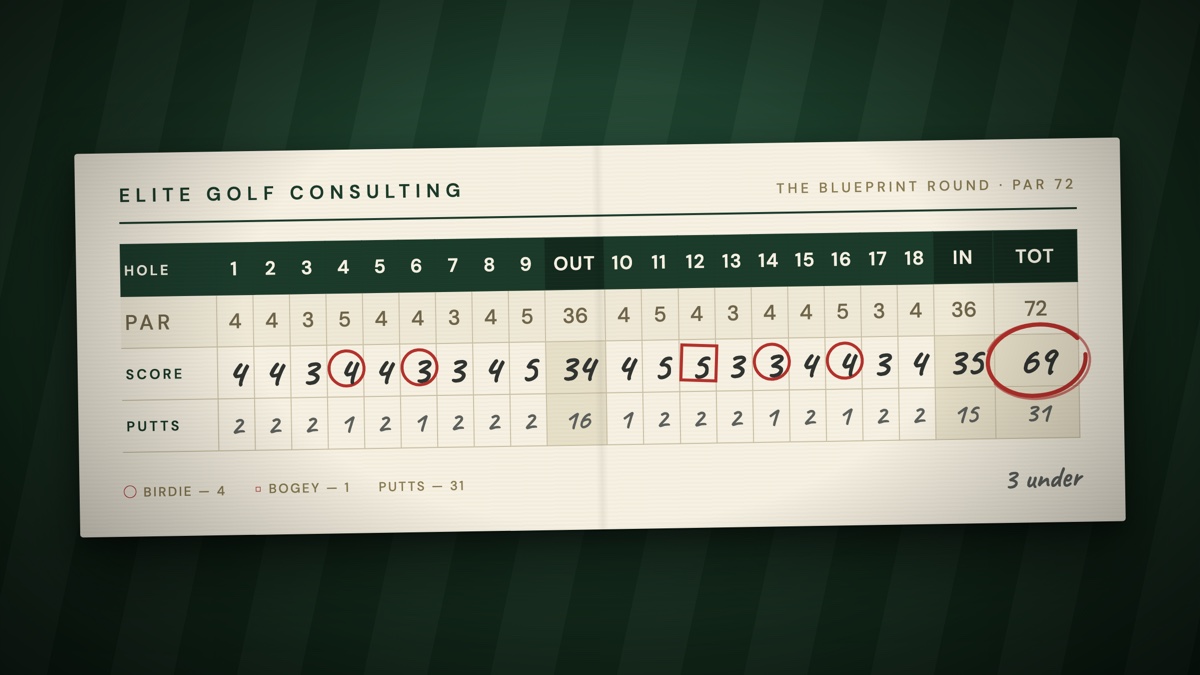
That's 69. Read it again and notice what isn't in there: no eagles, no hero shots, no career-best ball striking, no stretch of four birdies in five holes. Nothing you haven't already done a hundred times in pieces. The blueprint just puts the pieces on the right holes.
And here's what everyone says afterward, without exception — you'll add up the card, see the 69, and think that felt pretty easy. It's an odd feeling. The rounds you fight for are 74s. The one where you finally break 70 is usually the calmest four hours you've spent on a golf course, because nothing ever went wrong enough to require a rescue.
If you're reading this, you've been close. Maybe a lot of times. I believe you can do it — not as a motivational line, but because the number you need is already inside the golf you're playing right now. It's been waiting on a plan, not a swing.
For the view from the bottom of the ladder to the top — every rung, and the stat benchmarks that sit under each one — see the golf scoring benchmarks by handicap.
Go take the 6.

Keep Reading