Get Better
The Two Strokes You Give Away Before You Tee Off
One of them is in your body. The other is in your head. Neither needs a range, a lesson, or a new club — just the fifteen minutes most golfers spend in the parking lot.
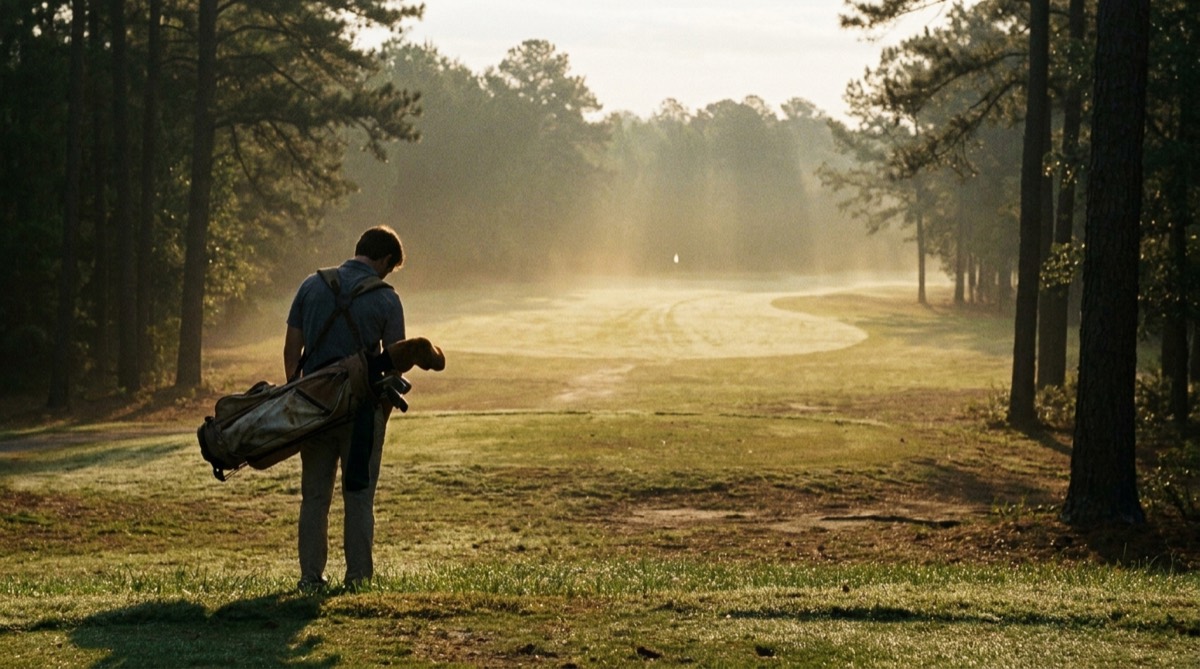
Everyone hunts for strokes in the expensive places. A new driver. A swing rebuild. Another lesson. The cheapest strokes in golf are sitting in the fifteen minutes before your tee time, and most golfers walk straight past them on the way from the car. You give away two strokes before you tee off — one with your body, one with your head — and both are there for the taking.
Here is the short version. The first stroke is physical: you arrive six minutes before your time, walk onto the first tee cold, and use holes one through three to warm up. The published estimates for what a proper warm-up is worth run from one and a half to two and a half strokes a round, and a cold start is a decision.
The second stroke is mental: you walk to the tee with no idea whether you're improving, so you hope instead of expect. A six-minute warm-up that needs no range fixes the first. Four honest questions and one silent sentence fix the second. In my experience the two together are worth two to five shots a round, and neither one requires a range, a lesson, or a new club.
What a warm-up is actually worth — the honest range
I want to be straight about the numbers here, because the people publishing them don't agree with each other. Golf Digest quotes Tyler Campbell of the Golf Performance Center in Ridgefield, Connecticut, saying players who did a deliberate dynamic warm-up before a competitive round saved an average of 1.5 strokes.
Will Shaw, a PGA professional with a PhD writing at Golf Insider, puts a proper warm-up at one to three shots. A coach writing on Substack estimates two to two and a half strokes for the average 18-handicap man or 25-handicap woman.
Underneath all of that is a 2004 study in the British Journal of Sports Medicine. Fradkin, Sherman and Finch had golfers perform a golf-specific warm-up five times a week for five weeks; their clubhead speed rose 24 percent while the control group barely moved. Speed is not score, but a body that swings faster and in sequence is a body that isn't guessing on the second tee.
So take the range, not the flattering number: somewhere between one and a half and two and a half strokes a round. That is stroke one in the title, and it is the conservative one. It also happens to be the gap between you and breaking 90 if you're a bogey golfer — that whole number is five pars and thirteen bogeys, and a cold start eats the pars.
Stroke one: the six-minute warm-up that needs no range
Most nine-hole courses don't have a range. Most golfers arrive six minutes before their time. So the warm-up that matters is the one you can do with no bucket, no bag on your shoulder, and no net. This is it:
- Arrive twenty minutes early, not six. This is the whole routine. Everything below fits inside the fourteen minutes you just found.
- Walk to the first tee. Leave the cart. Two brisk minutes gets blood into your legs and your heart rate off idle.
- Hips and shoulders, sixty seconds. Ten slow hip circles each way, ten arm swings across the chest, ten torso turns with a club held across your shoulders.
- Two-club swings, ten of them. Hold two irons together and swing slowly, letting the weight pull you through a full turn. This wakes up the sequence you actually swing with.
- Ten short putts if there's a practice green. Three-footers only. You are not practicing — you are reminding your hands what a made putt feels like.
- Choose your first tee shot before you step on the tee. For most golfers that's the 70% driver: the one that finds the fairway, not the one that finds the parking lot.
Nothing on that list is athletic. It is the bar being so low that stepping over it counts. This is Pillar 4 of the nine pillars of golf — Health — doing its plainest job: your body is the equipment, and you don't hit the first tee shot with cold equipment.
Stroke two: the check-in before the first tee
The second stroke is the one nobody writes about, because it doesn't come from a study. It comes from what you carry to the tee. Before I put a peg in the ground I ask myself four questions, and I answer them honestly:
- Am I proud of how I've been practicing?
- Do I have goals — for this round, and for the season it belongs to?
- Is my body a little sharper than the last time I played?
- Am I happy with my routines — the night before, the morning of, the shot in front of me?
None of these get fixed in the parking lot, and that is the point. They are things you layer into your game the more you practice and play. The questions are just a mirror. If the answer to all four is yes, you walk to the tee with something most golfers never bring: evidence. If two are no, you have your next fortnight's work, and you still play today — with today's game, not the one you're building.
If you've never set a goal for a round, start with the night-before routine: one main mission and two or three mini missions written down before you sleep. The check-in on the tee is only useful if there's something to check in against.
The silent sentence
Then, right before the first tee, comes one silent sentence. Mine is: I'm improving. Now let's show the course what I've got.
It isn't hype. It's a summary of the four answers. I've done the work, my body is ready, the goals are written, and the only thing left is to play.
After that, whatever happens, happens. A bad bounce is a bad bounce. But when you play like you are in control, the ball has a way of finding the hole faster — not because the sentence is magic, but because a golfer who arrives with evidence swings like someone who expects the shot, and a golfer who arrives cold and hoping swings like someone braced for the miss.
That is what the two strokes really are. One is a body that hasn't been asked to move yet. The other is a mind that hasn't been asked whether it believes. Both get handed back on the first tee, in the same fifteen minutes, for free.
Body and mind are the same pillar
When I built the nine pillars, Health was never just hamstrings. It is whether you arrive at the first tee rested, moving, and believing — and it compounds slowly and then all at once. A golfer who does the six minutes and asks the four questions plays the first six holes at the same standard as the last six. A golfer who does neither blames a swing thought on the third tee for a start that was really just cold.
This is exactly why the app scores Health as one of the nine pillars, round by round. You log whether you warmed up, you set your mission the night before, and you see the pillar score move as the layers build. The two strokes stop being a theory and start being a line on a chart you can point at.
Questions golfers ask about the first tee
How early should you arrive before a golf tee time?
Twenty minutes is enough, and it is the whole difference. Six minutes gets you to the tee cold and rushed. Twenty minutes gives you a walk, a few minutes of movement, some slow swings, a handful of putts, and one quiet moment before you put a peg in the ground. Nothing in that list needs a range.
Can you warm up for golf without a driving range?
Yes, and most golfers have to, because most nine-hole courses do not have one. Walk to the tee instead of riding, do hip circles, arm swings and torso turns with a club across your shoulders, make ten slow swings holding two irons together, and roll ten short putts if there is a practice green. That wakes up the sequence you swing with. Hitting a bucket is the least important part of warming up.
Does warming up actually lower your golf score?
By somewhere between one and a half and two and a half strokes a round, and the sources do not agree on the exact figure. Golf Digest's trainer puts a dynamic warm-up at 1.5 strokes, Golf Insider's Will Shaw says one to three, and a 2004 British Journal of Sports Medicine study measured a 24 percent rise in clubhead speed from a golf-specific warm-up. Speed is not score, but a body moving in sequence is not guessing on the second tee.

Keep Reading