Get Better
The 9 Pillars of Golf: The System I Built Living in a Van
Eleven years ago I was a washed up college player sleeping in my van with a set of clubs in the back. I had no coach, no money and no reason for anyone to believe in me. So I sat down and wrote out every single thing that actually makes a golfer better. There were nine of them.

I want to tell you where this came from, because the system does not make much sense without the story.
I played at San Diego State, on a team ranked fifth in the country, alongside guys who are on tour right now. And then I was done. Not injured, not retired, just finished in the way that happens quietly to most college players. The scholarship ends, the structure disappears and one morning you are a person who used to be good at golf.
Eleven years ago I was living in my van. That is not a metaphor I use to make a point in a blog post. It is where I slept, and my clubs were in the back, and the honest situation was that I could not afford lessons, could not afford a membership and could not afford to waste a single practice ball on the wrong thing.
Which turned out to be the most useful constraint I have ever had. When you cannot buy your way forward, you are forced to ask a better question. Not what should I work on today. Instead: what actually makes a golfer better, and in what order?
I wrote the list out by hand. It came to nine things. I have not found a tenth in eleven years of looking.
Why most golfers plateau at exactly the same place
Here is what I noticed once I had the list in front of me. Almost every golfer I have ever met works on pillar one. Only pillar one. Forever.
They go to the range, they beat drivers, they take a lesson on their takeaway, they buy a new shaft. Then they wonder why they have shot the same score for six years. It is not a mystery. They are pouring everything into one ninth of the game and leaving the other eight untouched.
You do not have a swing problem. You have a coverage problem. And the fastest improvement of your life is sitting in the pillars you have never once thought about.
So here they are. All nine.

Pillar 1. Golf 101: the basics
Driver, irons, wedges, chipping, putting. The physical skills. The ability to actually hit the shot when you have chosen it.
I am not going to pretend this pillar does not matter. It matters enormously, and it is first for a reason. If you cannot advance the ball, nothing else on this list saves you.
But notice what pillar one really is. It is five separate skills, not one. Most golfers spend eighty percent of their range time on two of them, the driver and the mid irons, which happen to be the two that matter least to their score. Your wedges inside a hundred yards and your putter are where the shots actually live. I wrote about that split in detail here: spend only 10% of your range time on your mid-irons.
Get honest about which of the five you are genuinely good at. Most people find they are strong at one, average at two and quietly terrible at two more.
Pillar 2. Course management
This is the cheapest golf improvement in the world and almost nobody buys it, because it does not feel like practice.
Course management is knowing which shot to hit before you stand over it. It is playing to the fat side of the green. It is taking the hero shot off the menu on the par 5 so that a routine five never becomes a seven. It is the difference between the golfer who shoots 79 and the golfer with the exact same swing who shoots 84.
You can gain four shots a round here without changing a single thing about how you swing the club. I laid out the whole arithmetic of it in how to break 80, and it is the same principle at every level.
Pillar 3. Will power
How much do you actually want it, and can you prove it on a Tuesday in February when nobody is watching?
Will power is the pillar that decides whether the other eight ever get used. It is showing up when it is cold. It is putting on the carpet at night because the course is closed. It is choosing the boring drill over the fun one.
Living in that van, this was the pillar I had the most of and it carried me a long way. When you have nothing else, the willingness to keep going is an actual competitive advantage. Most people quit long before they run out of talent.
Score yourself honestly here. Wanting it on the drive home from a bad round is not will power. Doing something about it on Wednesday is.
Pillar 4. Health
Your body is the equipment. Everyone obsesses over the equipment in the bag and ignores the one holding it.
Sleep, food, water, strength, mobility. A golfer who is rested and moves well plays the last six holes at the same standard as the first six. A golfer who is not, does not, and then blames a swing thought for a finish that was really just fatigue.
This pillar compounds slowly and then all at once. It is also the one where most amateur golfers have the largest untapped gain available, because the bar is so low. You do not need to become an athlete. You need to stop arriving at the first tee already tired.

Pillar 5. Confidence
Confidence is not a personality trait. It is evidence.
You cannot talk yourself into it on the first tee, and every golfer who has tried knows this. What you can do is build a bank of proof so large that the shot in front of you is obviously one you have hit before. That is what practice is really for. Not to build a swing, but to build a memory you can lean on when your hands are shaking a little.
The reason so many players lose it under pressure is that they never made the deposits. There is more on that here: overcoming pressure in golf.
Pillar 6. Goal and timeline
This is the pillar that changed my life, and it is the one almost nobody has.
Ask a golfer what he wants and he will say "get better." Ask him by when and the room goes quiet. That is not a goal. That is a mood.
A goal has a number and a date. Break 80 by October. Play in a state amateur next summer. Get to a 4 handicap by the end of the year. The number tells you what to practice. The date tells you how hard.
"Without a target and a plan, you don't know how to aim."
Cameron Tennant

When I was in that van I wrote down a specific championship and a specific year. Everything I did after that was measured against it. Not "was that a good practice session" but "did that move me toward the thing on the paper." Nine tenths of what I used to do at the range did not survive the question.
Pillar 7. Money and financial means
I include this pillar because leaving it out would be dishonest, and because leaving it out is why so much golf instruction is useless to normal people.
Golf costs money. Rounds, range balls, entry fees, travel, equipment, time away from work. Your financial situation sets the real boundary on how you can improve, and pretending otherwise just makes you feel like a failure for not following a plan you were never able to afford.
The point of this pillar is not that you need money to get good. I got to the round of 32 at a national championship having slept in a van. The point is that you have to build your plan around the resources you actually have. If you have forty dollars a week for golf, the correct plan is a completely different plan, not a worse version of a rich man's plan. Know your number, then design honestly inside it.
Being broke did not stop me. Being broke and pretending I was not would have.
Pillar 8. Data
You cannot fix what you have never counted.
Ask most golfers where their shots go and they will tell you a story. "I drove it terrible today." Then you look at the card and the driver was fine and they had five three putts. The story is almost always wrong, and the story is what they take to the range on Monday.
Fairways, greens, putts, up and downs, penalty strokes, scoring by hole type. Track it for a month and your practice plan writes itself, because the leak stops being an opinion. More on which numbers are worth your time: the golf stats that actually lower your handicap.
Data is also what makes the other eight pillars honest. It is very easy to believe your course management is good. It is much harder to believe it while looking at four doubles that all started with a driver you did not need to hit.
Pillar 9. Belief
Belief and confidence are not the same thing, and this took me years to understand.
Confidence is about the shot. Belief is about the person. Confidence says "I have hit this eight iron a thousand times." Belief says "I am the kind of golfer who belongs in this event."
This is the last pillar because it is the hardest and because everything above it feeds it. You cannot fake belief. You build it out of the other eight, one honest week at a time, until one day you are standing on a tee at a national championship and the surprising thing is that you are not surprised to be there.
A washed up college player living in his van had no rational reason to believe. I built the reasons instead.
What the nine pillars actually did
I ran this system on myself. Not perfectly, and not in a straight line, but consistently, for years.
I shot 68 at U.S. Mid-Amateur qualifying and took medalist, low man in the field. That got me into the championship itself, where I won my way into the round of 32.

For anyone who does not follow amateur golf closely, here is what that means. The winner of the U.S. Mid-Amateur receives an invitation to the Masters. So I was a handful of matches from Augusta National, having started the whole thing sleeping in a van.

I do not tell you that to impress you. I tell you because I want you to understand what the improvement actually came from. It was not a swing change. Nobody rebuilt me. What changed was that I stopped working on one ninth of golf and started working on all of it, in an order, against a date.
How to run this on yourself, this week
Take a piece of paper. Write the nine pillars down the left side. Score yourself out of ten on each one, honestly, the way you would score a friend rather than the way you would score yourself.
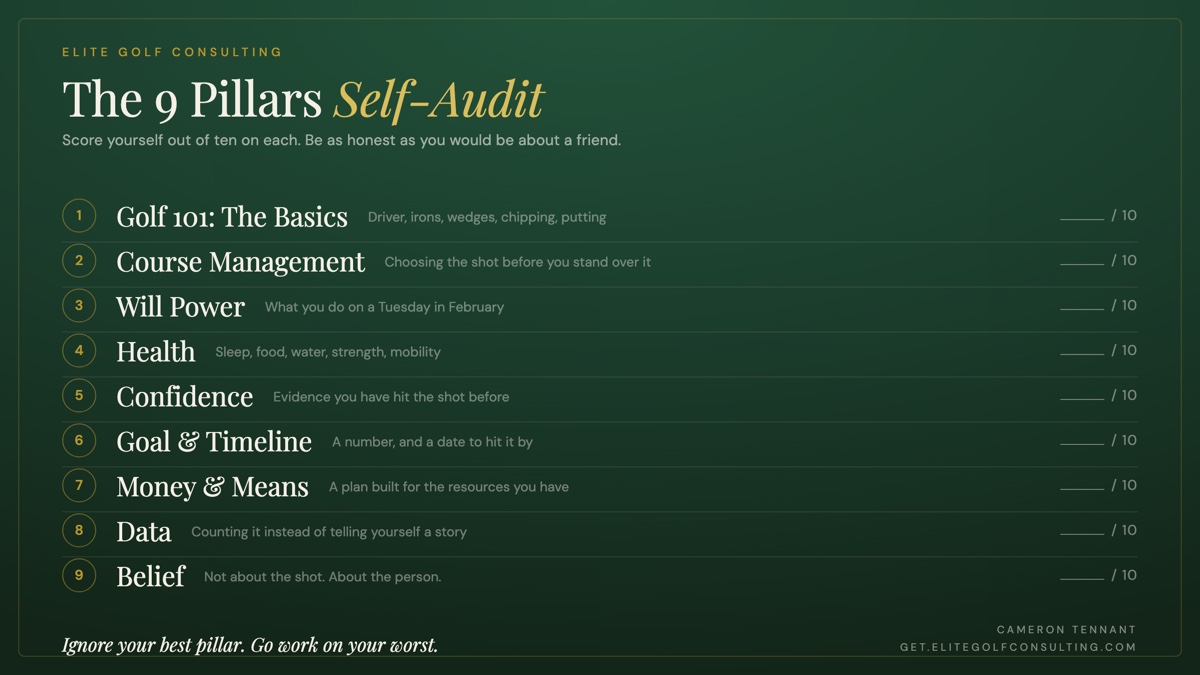
Then do the only thing that matters. Ignore your best pillar and go work on your worst one.
Everybody does the opposite. We practice what we are already good at because it feels good, which is exactly why the plateau lasts a decade. Your fastest available improvement is always sitting in the pillar you scored lowest, and it is usually not the swing.
Most golfers who do this exercise find their two lowest scores are pillar 6 and pillar 8. No goal with a date on it, and no data. Which means they have been practicing hard, for years, without a target and without a scoreboard.
Fix those two and the game gets noticeably easier inside a month. That is not a promise about talent. It is just what happens when you finally know where you are aiming.

Keep Reading