Get Better
How to Break 80 in Golf: You Already Have Every Shot You Need
79 is the number more golfers want than any other. And if you shoot in the 80s, the honest truth is that it isn't waiting on a better swing — it's waiting on you to stop treating it like a wall.

Ask a hundred golfers what they want and you'll get one answer more than any other. Not a new driver. Not a prettier swing. Seventy-nine. The 7 on the front of the card. The round you can talk about for the rest of your life.
And if you're an 80s player who has never done it — if you've signed for 81, 82, 80, 83 and walked off wondering what's missing — I want to tell you plainly: now is the time. Not next season. Not after the lesson package. Now. Because you are not missing a shot. You're missing a plan, and you're carrying a mental block that has been quietly costing you four shots a round.
Step one: 79 is a mental block, not a golf problem
This is the first thing, before any strategy. You have to decide it's easy.
I know how that sounds. But watch what actually happens to a player standing on 17 at even-money to break 80. His grip pressure goes up. His routine gets faster. He starts doing arithmetic between shots instead of picking targets. He plays the last two holes like a man defusing a bomb — and shoots 81. Not because he can't play those holes. He plays those holes all the time. He's just never played them while needing something.
The block is the whole thing. 79 has a story attached to it, and the story is what raises your heart rate. Strip the story off and it's a number like any other. It's one shot better than 80 — a number you've already beaten by getting close to it a dozen times.
You already own every shot this requires
Look at the evidence in your own history, because it's overwhelming.
You have made a birdie on a par 3. You have made a birdie on a par 4. You have made a birdie on a par 5. If you shoot in the 80s consistently, you have almost certainly had a nine in the 30s — which means you have already played half of a 79, and you did it without a single thing going perfectly.
You've chipped one in. You've had that moment where a 40-footer disappears and your playing partners lose their minds. You know what all of it feels like. None of that is theoretical for you.
So this isn't a project to build a new game. It's a project to compound the good habits you already have — to stop letting three or four thoughtless holes eat the good golf you're already playing. That's it. That's the entire job.

Now the math: 79 is seven over
Take a standard par 72 — four par 3s, ten par 4s, four par 5s. Breaking 80 means signing for 79, and 79 is 7-over par.
Seven shots. That's your budget for the entire day, and here's the part nobody says out loud: you can make a double bogey, and several bogeys, and still shoot 79. The round does not have to be clean. It has to be planned. Let's spend the seven.
Step 1: Par every par 5 (+0)
This is the key to the whole card, and it's the one most 80s players get backwards. You've been treating the par 5 as your birdie hole. Stop. Treat it as four guaranteed pars.
A par 5 is three ordinary shots and two putts. That's all it is. You do not need to reach in two, and going for it from 240 out of a hanging lie is exactly the swing that turns a routine 5 into a 7. Take the hero shot off the menu before you leave the first tee. Hit it, wedge it, take your two putts, walk to the next hole having spent nothing. That third shot is where the par actually lives, which is why it's worth knowing what your wedge score is before you blame the driver.
Four par 5s, four pars. You're at even par across those holes and you haven't hit a single difficult shot.
Step 2: Never three-putt (+0)
Par the par 5s and eliminate three-putts. Those are the two things. They sound like the easiest asks in golf, and they're the two things almost nobody does — because almost nobody practices speed control on the greens.
Notice this step adds zero to your budget. That's the whole point of it. Two putts a hole is baked into every number on the card. The three-putt is what quietly dismantles the plan: it turns your par on the par 5 into a bogey, and your bogey on the par 3 into a double, and by the 13th the seven shots are gone and you're grinding just to shoot 82 again.
And it is almost never a stroke problem. It's a distance problem. Nearly every three-putt starts with a lag that finished six feet away instead of two. Get the pace right from forty feet and the next one is a tap-in. If you want the drills, I laid them out here: the putting practice that actually ends three-putts.

Step 3: Play the par 3s at two over (+2)
Four par 3s. Give yourself two over across all four — two pars and two bogeys. For a player who shoots in the 80s, that's not a stretch, it's a Tuesday.
Play them the boring way: middle of the green, never the tucked flag, two putts, move on. The ball is teed up, you get to pick your number, and there's no second shot from the rough to worry about. Take your two bogeys without a word of complaint. They're already in the budget.
You're now 2-over, with eight holes played and ten to go.
Step 4: Budget one double (+2)
Something is going to go wrong. It always does. So write the double bogey onto the card before the round starts instead of letting it detonate the round when it arrives.
One lost ball. One out of bounds. One tree. That's a double, and you are allowed exactly one. Spend it, shrug, and keep playing the plan — because the round-killer isn't the double, it's the second one that shows up on the very next tee while you're trying to win the two shots back.
That's 4-over with nine holes left to play.
The reveal: one birdie and nine ordinary holes
Count what's actually left. You've handled four par 5s, four par 3s, and the one hole where it all went sideways. That's nine holes gone, you're 4-over, and the nine holes remaining are all par 4s.
You've spent four of your seven shots. Three left, across nine holes. Here's what that buys:
One birdie. Four bogeys. Four pars. That's +3. Add it to the 4-over you're carrying and you sign for 79.
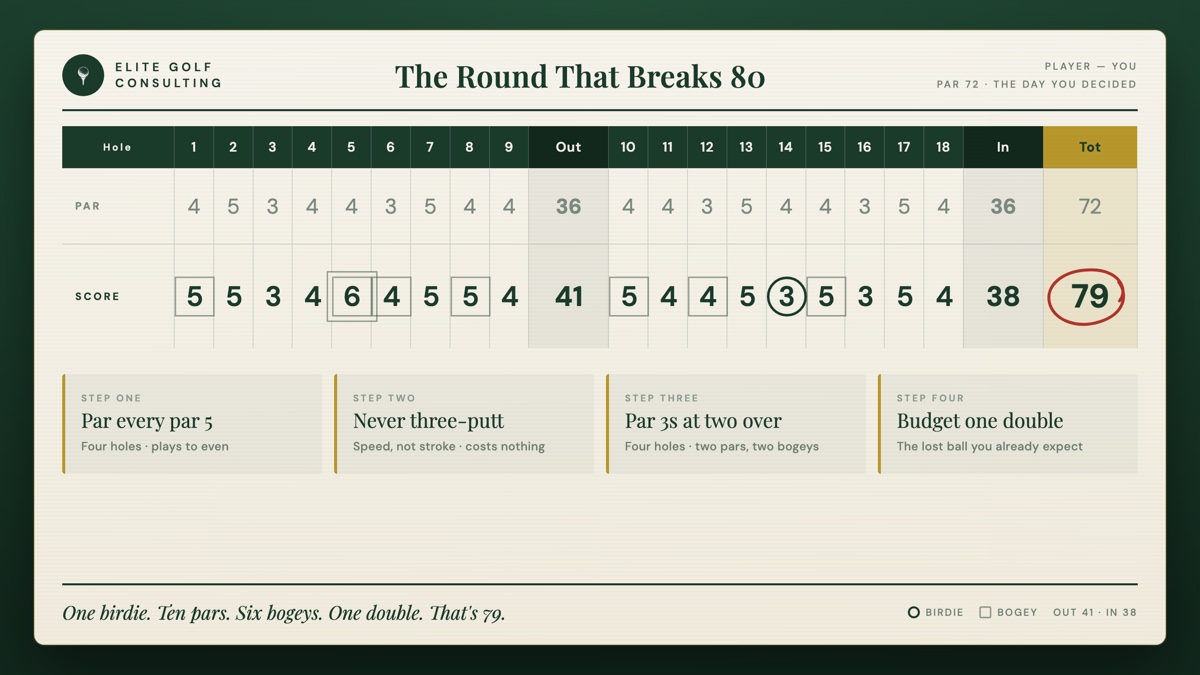
Look at the full day's tally, because this is the part that should change how the number feels: one birdie, ten pars, six bogeys, and a double bogey. That's a 79.
Six bogeys. And a double. On the round that gets you into the 70s for the first time. That is not a heroic day of golf — that's a Saturday where nothing went especially well and nothing went catastrophically wrong.
(Check the card before you play — some par 72s run five par 3s and five par 5s. The hole types shift; the plan doesn't.)
Where the one birdie comes from
Here's the good news about the only genuinely hard ask on the list: you don't have to go hunting for it. In my experience the birdie shows up on its own, and it shows up precisely because of everything above.
When you're not reloading off tees, you're playing approach shots from the fairway. When you're not stewing about a three-putt, your head is clear over a 15-footer. When nothing has blown up, nothing feels desperate — and somewhere around the 12th, a wedge finishes eight feet away and you make it, because there was no reason not to.
That's what momentum actually is. Not a feeling you summon. The natural byproduct of a round where you haven't wrecked anything.
The question that protects the number
When it gets tight — and it will, somewhere around 16 — the temptation is to start protecting. Steering tee shots. Playing safe in ways that aren't actually safe. That's how a 78 becomes an 81.
So use one question instead, on every shot from there in: "What's the shot I've hit a thousand times?"
Not the best shot available. Not the one that would look incredible. The ordinary one — the stock club, the middle of the green, the boring lag to three feet. You already have every shot this round requires. The finish isn't about finding a new one. It's about having the discipline to keep hitting the ones you own while your hands are shaking a little.
Par the par 5s. Refuse to three-putt. Two over on the par 3s. Forgive yourself one double. Then go find one birdie in nine par 4s and play the rest like it's a practice round.
The 79 has been in your bag for a long time. Today is a fine day to go get it.
If you want the numbers underneath the number — putts, greens, penalties, wedge score, and what each one should read at your level — they're all in the golf scoring benchmarks by handicap.
Go take the number.

Keep Reading