Get Better
What Is a Wedge Score — and Why Yours Is Probably Over 3.0
Almost nobody tracks this number, which is strange, because it's the one that decides your score. I thought I was a good wedge player for about fifteen years. Then I counted.
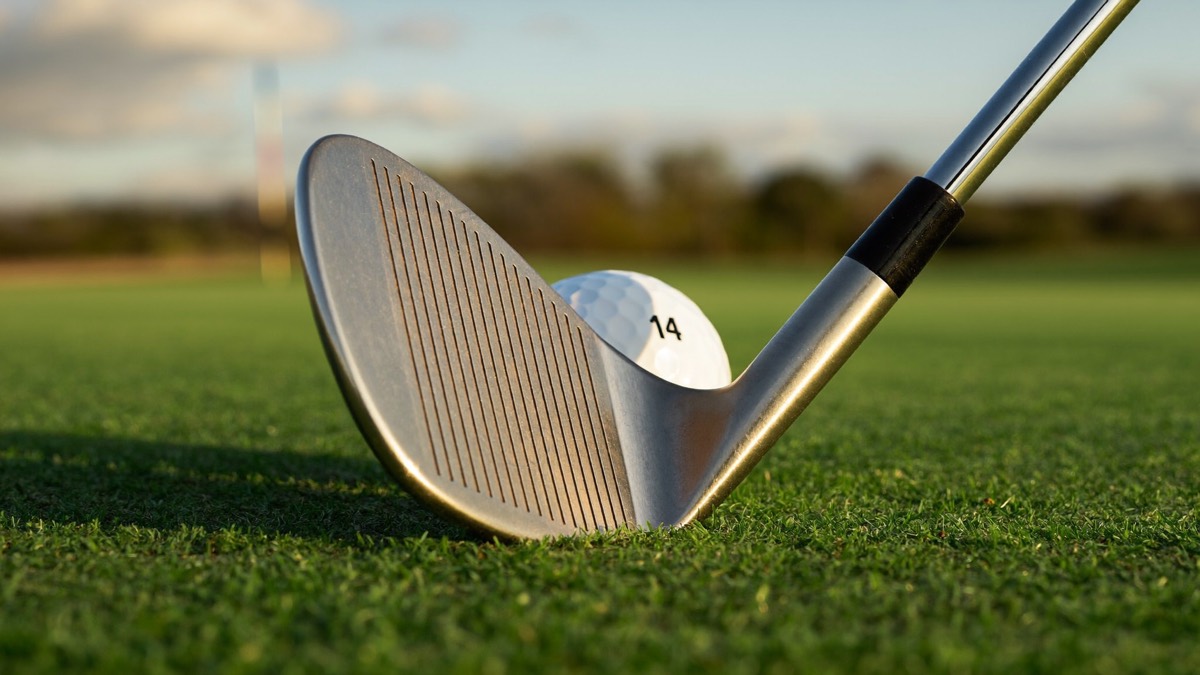
Here's a stat almost no amateur golfer keeps, and it might be the most honest one there is.
What is a wedge score?
Your wedge score is the number of strokes it takes you to hole out from the moment you have a wedge in your hand, 20 yards or more from the green. Not how the shot felt. Not whether you hit the green. The number.
- 3 — on the green in one, two putts. That's your par.
- 2 — on in one, one putt. That's the shot that wins you holes.
- 4 — you leaked one somewhere, either in the air or on the green.
Track it for every qualifying hole in a round, add the strokes, divide by the number of holes. That average is your wedge score. Under 3.0 is the line. Above it, your wedges are costing you strokes even on days you feel like you're striking it well — and that gap is exactly what makes this number worth keeping.
They're called the scoring clubs for a reason
Wedges have a nickname in this game: the scoring clubs. Everybody says it. Almost nobody checks whether it's true for them personally.
Think about where your bad numbers actually come from. It's rarely the driver — a bad drive costs you a stroke and you know it immediately. It's the hole where you were sitting 70 yards out in the fairway, in perfect shape, and walked off with a bogey. Nothing dramatic happened. You just made a 4 where a 3 was sitting right there.
Do that five or six times a round and you've given away a handful of shots without ever hitting a shot you'd describe as bad. That's the whole problem with wedges: they fail quietly.
I thought I was good with my wedges. I was not.
I played Division I golf at San Diego State, on a team ranked fifth in the country, next to guys who are on tour now. If you'd asked me at any point in those years how I was with a wedge in my hand, I'd have told you I was solid. Better than solid.
Then I started tracking it. And I was not averaging under 3.
That was a genuinely bad week for my ego. I sat with it and worked out what was actually happening, because the obvious explanation — that I was hitting bad wedge shots — wasn't true. I wasn't chunking them. I wasn't blading them across greens. I was making clean contact on nearly all of them.
I just wasn't hitting them close enough.
That's the distinction that took me years to see, and it's the one I want you to have for free. Good contact and a good wedge score are not the same thing. You can flush a 78-yard shot to 45 feet and feel great about it walking to the green, and then two-putt at best and three-putt more often than you'd like. The shot was fine. The result was a 3 or a 4 that should have been a 2.
The numbers say this is normal — and that's the point
Shot Scope's data on amateur approach play puts the average proximity from 60 to 100 yards in the fairway at about 40 feet. Forty feet. That's not a makeable putt for anyone reading this, and it's a real chance of a three-putt.
For comparison, PGA Tour players average roughly 18 feet 5 inches from 100 yards, and only about 4% of their shots from that distance finish inside 3 feet. Even the best players in the world aren't stuffing wedges to tap-in range — they're just consistently in the 15-to-20-foot window instead of the 40-foot one.
And on Mark Broadie's PGA Tour baselines, built from ShotLink data, a tour player takes about 2.8 strokes to hole out from 100 yards in the fairway. That's their wedge score at the long end of the range. Not 2.2. Not 2.5. Roughly 2.8.
So the target isn't perfection. The target is 2.9-something instead of 3.3-something. That's the whole game, and it's completely reachable — it just requires knowing where you actually stand, which is what tracking the right golf stats is for.
Fix one: know thy clubs
So I went to work. And the first thing I found was embarrassing.
My sand wedge said 56 degrees on the sole. Measured, it was a 54. My lob wedge said 60. It was a 59.
This is not unusual, and that's the part worth knowing. Manufacturing tolerance on loft is commonly plus or minus one to two degrees straight out of the box. On top of that, lofts drift over time — hosels bend a little from ground contact and from years of range sessions, and a wedge that's been in your bag through a few seasons may not be what it was the day you bought it.
Two degrees doesn't sound like much until you realise what it does to your gapping. I thought I had a 4-degree gap between two clubs. I had 5 between one pair and 3 between another. Which means every yardage chart I had in my head was slightly wrong — and I'd been trusting it, and adjusting my swing to make up the difference, for years.
How to actually check yours
So: get your wedges measured. Any decent club fitter will put them on a loft-and-lie machine in ten minutes. Then go find your actual carry numbers — full swing, three-quarter, and half — for each one, on grass if you can. Write them down. That's it. That's the whole fix, and it costs an afternoon.
I did not know my wedges as a Division I college golfer. I figured it out in my senior year, which was too late to do anything with it. You don't have to wait that long.
Fix two: track it for seven holes
You don't need a full season of data. You need one round, and you only count the holes that qualify — the ones where you had a wedge in hand from 20 yards or more.
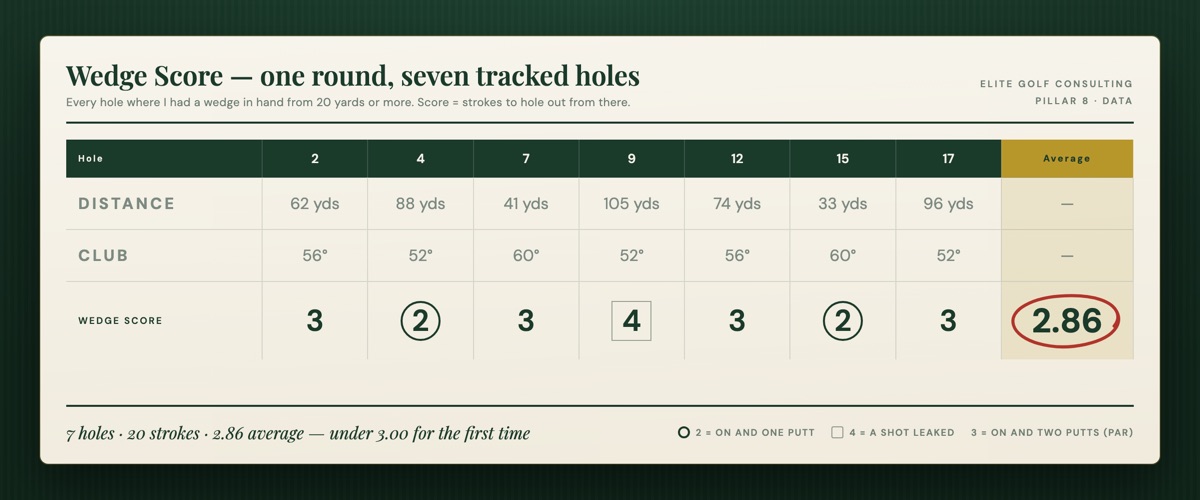
Log four things per hole: the distance, the club, the strokes to hole out, and nothing else. Seven holes is usually enough to see it. Most golfers who do this for the first time land somewhere between 3.1 and 3.5, and they're surprised, because the round didn't feel like that.
Then read the card properly. If your 3s are coming from being on the green in one and two-putting from distance, your problem is proximity — you need better yardages, not better technique, and it's worth pairing this with practice that actually kills three-putts. If your 4s are coming from missing greens with a wedge in your hand, that's contact and club selection. Two very different practice plans, and the card tells you which one is yours.
What this is worth
In my experience — mine, and the golfers I've worked with since — knowing your wedges and tracking your wedge score is worth four to six shots a round over time. Not next Saturday. Over time.
It's not a swing change and it's not a new set of clubs. It's the difference between guessing at 82 yards and knowing that 82 yards is a three-quarter 54 for you, every time. Multiply that by the six or seven wedge shots you hit in a round and you can see where the strokes were hiding the whole time.
That's also the fastest route through the scoring barriers. Most golfers trying to break 80 already own the shots — they're just spending an extra half-stroke on every wedge hole and calling it bad luck.
Wedge score lives under Pillar 8: Data in the system I built the app around, and "know thy clubs" sits under Pillar 1, the fundamentals. They're two of the nine pillars, and they're the two I'd hand a golfer first if I could only give them two.
It's also one of five numbers worth keeping. The other four, and what each should read at your level, are in the golf scoring benchmarks by handicap.
Go count your next seven wedge holes. Whatever the number is, at least it'll be true.

Keep Reading