Get Better
Why Your Range Game Isn’t Transferring to the Course
Rhythm is easy on the range. On the course the only rhythm you get is your routine, and most golfers never practice it. Here are the five reasons, and what to do about each one.
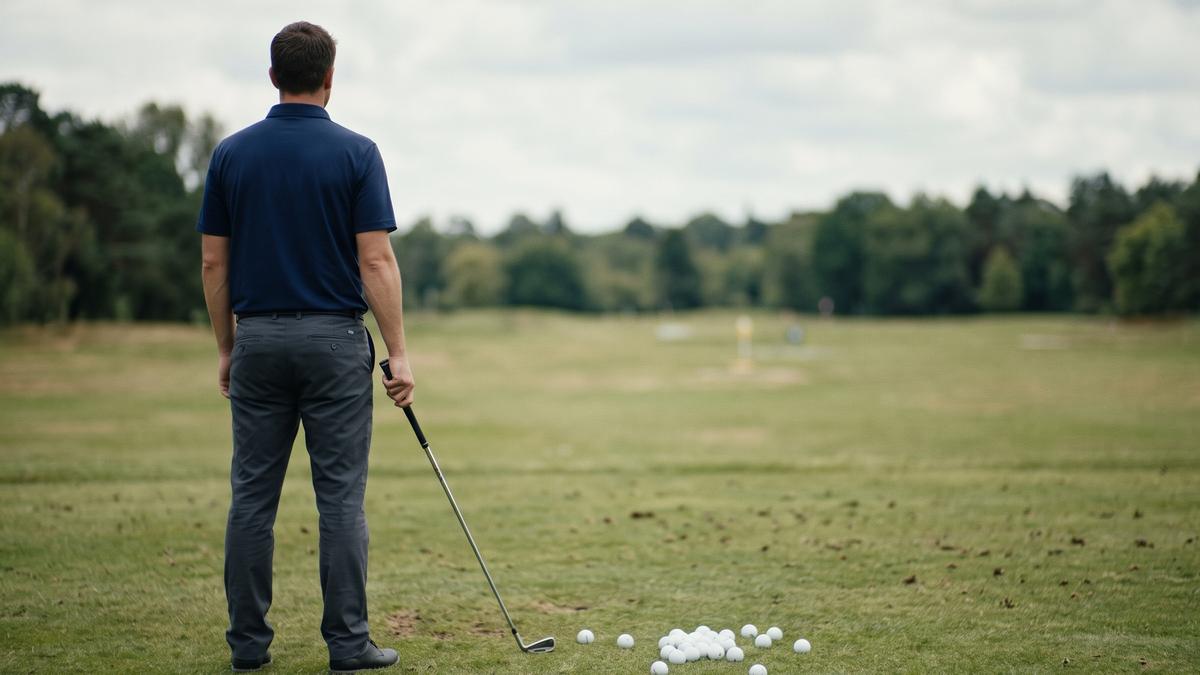
If you hit it great on the range and keep asking, “Why can’t I take my range game to the course?”, your swing is probably not the problem. The range and the course are two different environments, and most golfers only practice for one of them.
On the range, rhythm is easy: same club, ball after ball, flat ground, no waiting and nobody watching. On the course you get long waits, distractions, tee boxes that aim you at trouble, and the pressure of people seeing the result. The only rhythm you get out there is your routine, and most golfers never practice their routine on the range. Fix that, and the swing you already own starts showing up on the first tee.
1. Rhythm is easy on the range. The course takes it away.
It’s easy to get into a rhythm on the range. The next ball is already at your feet, the club is already in your hands, and nothing interrupts you. By the tenth seven iron in a row, almost anybody looks like a player.
The course doesn’t work that way. You hit a shot, then you walk, wait for the group ahead, look for a ball, talk, and wait again. The Rules of Golf recommend making a stroke in no more than 40 seconds once you’re able to play (Rule 5.6b). Everything else is waiting. Shoot 90 in a four-hour round and that’s one swing every two minutes and forty seconds, on average.
So the question isn’t whether you can find your rhythm. It’s whether you can produce a good swing cold, after standing around for three minutes, with a different club than the one you hit last. That’s a different skill, and the range doesn’t train it unless you make it.
There’s research on this. In a 2017 study in Perceptual and Motor Skills, Fazeli, Taheri and Saberi Kakhki split thirty novice golfers into three groups: blocked practice, random practice, and no practice at all. The two practice groups putted for six straight days. The random group putted worse than the blocked group during practice, then putted more accurately when they were tested a week later.
These were beginners and it was putting, so don’t stretch it too far. But the pattern is worth knowing: the practice that feels smooth is not always the practice that sticks.
2. Your routine is the only rhythm you get on the course
Out there, your pre-shot routine is your rhythm. It’s the one thing you can repeat on every shot, whether you’ve been waiting thirty seconds or ten minutes. Step behind the ball, pick the target, take a breath, walk in, go. Same order, same pace, every time.
Most golfers don’t practice their routine on the range. They rake a ball over and hit it. Then they get to the course and try to use a routine they’ve never rehearsed, on the shots that matter most.
The evidence for routines is strong. A 2021 meta-analysis in the International Review of Sport and Exercise Psychology (Rupprecht, Tran and Gröpel) pooled 112 effect sizes from sport studies and found that pre-performance routines improved performance in both low-pressure and pressurised conditions. The type of routine didn’t change the result. Having one did.
So take it to the range. You don’t need it on every ball. Do it on the last twenty: full routine, one ball, one target, then step away and start again. For how to spend the rest of the bucket, see how many balls you should hit at the driving range.
3. The range is flat and aimed for you. The course is neither.
The range is flat, and there’s nothing out there to distract you. On a mat the lie is perfect every time, and the mat usually points you straight down the middle, so you’re aimed before you’ve thought about it.
The course gives you none of that. A tee box can aim you slightly offline, straight at the water, and if you’re not aware of it you’ll set up square to the tee box and hit a good shot into trouble. You’ll blame the swing. The swing did its job. The aim was wrong before you took the club back.
This is why the routine starts behind the ball, not over it. Pick your line from back there. Find a spot a few feet in front of the ball on that line and aim the clubface at it. On the range, practice it by choosing a target the mat isn’t pointing at, and by changing targets every few balls.
4. You can’t simulate pressure on the range
On the range it’s next to impossible to simulate pressure. A bad shot costs you nothing. You drag over another ball and nobody remembers the last one.
On the course there’s something every human hates feeling: embarrassment. The first tee with a group watching. The playing partner you want to impress. The scorecard that keeps what you did. Most of what golfers call pressure is the fear of looking bad in front of other people.
You can’t recreate that on a mat, but you can get closer. Give a shot a consequence: one ball, one target, no second try. Practice with a friend and keep score. And when the real thing shows up, remember that pressure is a gift. It means you care about the shot in front of you.
5. Courage comes from the course
Courage comes from the course. You can’t build it on a mat, because there’s nothing on a mat to be brave about. You build it by standing on real tees, with real trouble and real people around, and hitting the shot anyway.
That means playing more, not only practicing more. Nine holes after work counts. A round by yourself counts. Every time you walk through your routine on a shot that scares you a little, you have a bit more courage for the next one.
Then your preparation and your routine do the rest. Preparation is knowing your numbers, your plan and your targets before you get there. It starts the night before the round. Routine is doing the same thing over every ball. Together they’re what create consistency. A new swing won’t.
How to practice so your range game transfers to the course
You don’t have to change the whole session. Change the last third of it:
- Use your full routine on the last twenty balls. Behind the ball, target, breath, walk in, hit. Step away completely between each one.
- Change the club and the target on every ball. Driver, then a mid iron, then a wedge, the way a hole actually goes.
- Wait between shots. Take a drink, look around, let the rhythm go. Then find it again with your routine.
- Aim yourself. Pick a target the mat isn’t pointing at and line up from behind the ball.
- Put something on it. One ball, one chance, a friend keeping score.
It will feel worse than raking and hitting. That’s the point. It feels like the course.
It’s time to bring your best to the course
The range didn’t lie to you. The swing you have there is real. What’s missing is everything the course adds: the waiting, the aiming, the people watching, and the nerve to hit it anyway. Those are skills, and they can be practiced.
They’re also easier to build with other golfers than alone. That’s what we do inside The Country C1ub: we work on our games together, as a team. There’s a guest fee to come in, and you can see the guest rate here. It’s time to bring your best to the course.
Questions golfers ask about taking their range game to the course
Why do I hit the ball better on the range than on the course?
Because the range gives you everything the course takes away. On the range you hit the same club ball after ball, from a flat lie, with no waiting and nobody watching, so rhythm comes easily. On the course you wait minutes between swings, change clubs on every shot, aim yourself, and feel the pressure of other people seeing the result. Your swing is the same. The conditions are not, and most golfers only practice for the easy ones.
How do I practice my pre-shot routine at the driving range?
Use it on purpose for part of every session. You do not need it on every ball. On the last twenty balls, go through the full routine each time: step behind the ball, pick a specific target, take one breath, walk in and hit. Then step away completely before the next one. Change the club and the target on every ball so each shot starts cold, the way it does on the course.
How do you simulate pressure at the driving range?
You cannot fully recreate it, because nothing on the range costs you anything. You can get closer by giving a shot a consequence. Hit one ball at one target with no second try. Play a made-up hole with a fairway and a green you have to hit. Practice with a friend and keep score. The real thing still has to be learned on the course, with people watching and a scorecard that keeps what you did.

Keep Reading